Europe Travel Cluster
Europe Travel Hub — Safety, eSIM, Routes
The Ultimate Blueprint to Continental Bikepacking on a Budget
The Continental Bikepacking Operations Manual for Crossing Countries, Borders and Continents by Bicycle
June 2026 · 35 min read · Practical guide
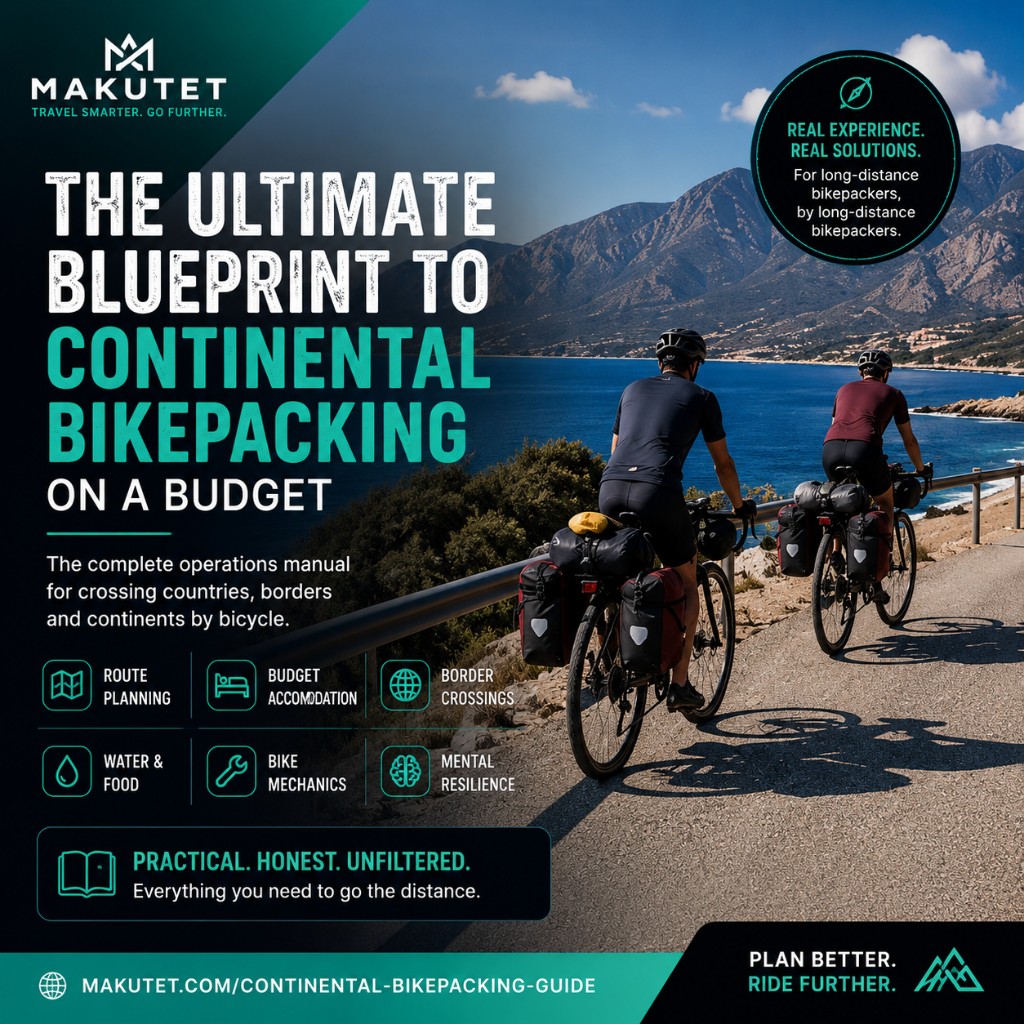
Long-distance touring proves that continents are crossed one pedal stroke at a time.
Editorial Note
This guide draws on practical long-distance bicycle touring experience across the United Kingdom, Europe, Russia, Turkey, Thailand and Vietnam. It is not intended as a country-by-country guide to every continent — conditions vary enormously around the world, and honest experience has limits.
Instead, this guide focuses on the universal challenges that every long-distance cyclist eventually faces: finding water, finding shelter, managing money, crossing borders, staying connected, maintaining a bicycle, dealing with weather, and looking after physical and mental wellbeing.
The roads change. The countries change. The solutions change. The challenges remain surprisingly similar.
Table of Contents
1. The Economics of Bikepacking
The most persistently repeated myth about long-distance bikepacking is that it requires significant financial investment. It does not. A loaded touring bicycle, moving steadily across a continent, is one of the most economically efficient forms of long-term travel that exists. Understanding why requires unpacking the actual cost structure.
The core expenses of long-distance touring are food, accommodation, and the occasional mechanical repair. That is essentially it. There is no flight to catch. There is no taxi from the airport. There is no transfer to the hotel. The bicycle is simultaneously your transport and your accommodation infrastructure — it carries your tent, your sleeping bag, and your kitchen. Every kilometre you cover is free.
A budget-conscious tourer crossing Europe and into Asia can comfortably average €25–40 per day. This is not a heroic achievement requiring extreme sacrifice — it is the natural consequence of moving slowly, camping regularly, eating from supermarkets and markets, and accepting hospitality when it is offered. At that rate, a six-month continental tour costs roughly the same as three months of rent in a Western European city.
Camping-First Budget
Primarily stealth camping and Warmshowers hosting. Supermarket food, occasional hostel. This is the natural default for most long-distance tourers and is entirely comfortable with experience.
Mixed Accommodation
Hostels or guesthouses two to three nights per week. Cafe meals in addition to self-catering. Comfortable without significant luxury. The standard approach for most tourers in expensive regions.
Comfortable Touring
Regular guesthouse or budget hotel accommodation. Restaurant meals, occasional guided experiences. Appropriate for tourers who want the cycling experience without the camping commitment.
On Equipment Costs
Bicycle touring equipment marketing is designed to convince you that expensive equipment is necessary. It is not. A reliable steel touring bicycle, bought second-hand for €400–800, will outlast and outperform a €3,000 boutique gravel bike on a long continental tour. The most important quality in a touring bicycle is not weight or aesthetics. It is that a local mechanic can fix it with parts available in a small town anywhere in the world. Exotic components fail expensively and unrepairable in inconvenient places.
2. Accommodation Systems
Long-distance cycle touring develops a completely different relationship with accommodation from other forms of travel. You rarely know exactly where you will sleep tonight. You rarely book in advance. The ability to improvise — and to read landscapes for camping potential — is something that develops naturally over the first few weeks of touring.
🏕️ Stealth Camping
Stealth camping — setting up a tent in a location without specific permission, typically arriving after dusk and leaving before sunrise — is the backbone of budget cycle touring. The practice exists on a spectrum from genuinely wild camping in remote forest to simply pitching on the edge of a field behind a hedge outside a village. The principles are consistent: arrive late, leave early, leave no trace, create no fire, and be visible to nobody.
In most of Western and Central Europe, Scandinavia, the UK and the vast majority of Asia, stealth camping in genuinely rural areas is, in practice, low-risk. Land ownership and camping laws vary enormously by country — Norway's allemansrätten gives legal wild camping rights; England and Wales explicitly do not. In practice, a cyclist in a small tent in a field corner at 10pm is not a priority for anyone. Common sense, respect for land and quiet departure solve most problems before they begin.
The skills that matter most are reading landscapes quickly — identifying flat, sheltered, private, well-drained ground — and not overthinking it. The perfect campsite rarely exists at the perfect moment. The acceptable campsite, found at 7:30pm before the light fully fades, is the skill that matters.
The Golden Campsite Rule
Never pass a genuinely good campsite late in the day.
🤝 Warmshowers — The Cycling Community's Secret
Warmshowers is a global hosting network built exclusively for bicycle tourers. Hosts offer whatever they can — a spare room, a garden to pitch a tent, a shower, a meal, local knowledge, a conversation. The network currently has hundreds of thousands of members across the world, from major European cities to rural Vietnamese villages. It costs nothing to use.
The quality of a Warmshowers stay cannot be overstated. It is not just accommodation — it is access to someone who understands what you are doing, who can advise on local roads, who can point out the water source you did not know about and warn about the dog pack three kilometres ahead. The conversations that happen around a Warmshowers dinner table are among the genuinely memorable moments of long-distance touring.
Practical reality: not every request receives a response, particularly in rural areas with fewer hosts or during busy periods. Send requests three to five days in advance. Write a genuine personal message — not a template. Hosts are doing you a significant favour. Treat that accordingly.
🏠 Hostels, Guesthouses & Camping Municipals
Hostels serve specific functions in a touring schedule: laundry, charging, a hot shower, resupply of consumables, and — critically — a social reset. After a week of solo camping, a hostel common room is genuinely valuable for mental wellbeing. Budget hostels in most of Europe and Asia typically run €10–20 per night, which is worth budgeting for every few days.
French camping municipals deserve special mention: town-run campsites that often cost €5–8 per night, offer hot showers, electricity and security, and are found in most towns of any size. For cycling through France, they are invaluable. Many Spanish and Portuguese towns run similar schemes. In Southeast Asia, guesthouses in the €5–15 range are abundant even in remote areas, making camping less necessary than in Europe.


Find Accommodation on Rest Days
Compare hostels, guesthouses and hotels across every country on your route.
3. Connectivity and Digital Survival
The assumption that long-distance cycle touring should involve disconnection from technology is romantically appealing and practically dangerous. Mobile data on a long tour is not a luxury. It is navigation, translation, weather forecasting, emergency communication, accommodation booking, money management, border research and route updating. Without it, every one of these tasks becomes significantly harder.
The practical solution for most long-distance tourers is a travel eSIM — a digital SIM that can be loaded with local data plans without swapping physical cards at each border. For a tour crossing multiple countries, this removes the logistical frustration of finding local SIM vendors, navigating foreign phone shops and managing multiple physical cards.
Navigation Tools
Organic Maps
Essential offline navigationFree, open-source, remarkably detailed maps that work entirely without data. Download country maps before crossing borders. Faster and more cycling-friendly than offline Google Maps. The essential primary navigation tool for touring cyclists.
Komoot
Route planningThe best tool for planning cycling-specific routes in advance. Excellent surface type information, elevation profiles and community-contributed route data. Plan segments at home before riding them.
Ride With GPS / Gaia GPS
Advanced route managementMore feature-rich options for tourers who want detailed GPX track management, route history and enhanced mapping. Useful for complex routing in remote areas with limited mapping.
iOverlander
Community-sourced stopsA community database of camping spots, water sources, repair shops, border crossing details and practical notes contributed by overlanders and tourers. Invaluable in regions with limited conventional touring infrastructure.
Essential Tool — Download Before You Leave
Google Translate Is Not Optional
In a rural Turkish petrol station at 9pm, trying to explain that your rear derailleur has failed and you need to know where the nearest town with a bicycle shop might be — the quality of your translation tool matters. Google Translate with offline language packs downloaded handles this and every other daily communication challenge. The camera translation feature — which translates text in real time through the phone camera — transforms menus, road signs, shop labels and documents from obstacles into readable information.
Download language packs for every country on your route before departure. This includes obvious languages (French, German, Turkish) and less obvious ones (Vietnamese, Russian, Thai). The download takes minutes per language and costs nothing. The value in practice is enormous.
Travel eSIM Options for Long-Distance Tourers
Airalo
Best all-aroundBroadest country coverage (200+), most polished app, reliable carrier partnerships. The default recommendation for most tourers.
Yesim
Best for long staysCompetitive 30-day plans, integrated VPN, strong Southeast Asia coverage. The right choice for tourers spending extended time in each country.
Saily
Best value short plansAggressive pricing on short-duration plans. Good for crossing smaller countries or as a supplementary option.
Drimsim
Best universal coverageOne eSIM, 230+ countries. Pay-as-you-go model suits light data users on complex multi-country routes. Good as a backup.
For a detailed comparison of every major travel eSIM provider, including carrier partnerships by country, data allowances and pricing tables, see our Best Travel eSIM 2026 guide.
4. Financial Survival on the Road
Financial systems that work well in your home country often work poorly across multiple foreign countries and currencies. Long-distance tourers cross borders at irregular intervals, encounter different ATM networks, sometimes go days between banking infrastructure, and need to manage cash reserves without carrying excessive amounts.
Wise and Revolut — The Standard Solution
Both Wise and Revolut offer multi-currency accounts with interbank exchange rates and physical debit cards. For a touring cyclist, this means withdrawing local currency at near-perfect exchange rates rather than paying bank conversion margins of 3–5%. Over a six-month tour, this difference is significant. Both cards are widely accepted. Both work in ATMs globally. The practical advice is to carry both — from different underlying banks — so that if one card is blocked, declined or damaged, the other still works.
ATM Strategy and the DCC Trap
Dynamic Currency Conversion (DCC) is the practice of ATMs offering to convert your withdrawal into your home currency at the time of transaction. This always involves a poor exchange rate. When an ATM asks "Would you like to be charged in [your home currency] or [local currency]?" — always choose local currency. Always. The ATM's rate is never competitive.
When finding ATMs in less-developed regions, prioritise machines inside banks over standalone street ATMs. Use ATMs during banking hours when possible — if a card is swallowed, you can immediately speak to a human. Always cover the keypad when entering your PIN.
Emergency Cash Protocol
Carry an emergency cash reserve of USD $100–200 (or equivalent EUR) stored separately from your wallet — inside a hidden layer of your panniers or taped to the inside of a bag. This is not spending money. It is the fund that gets you to a bank branch after a card theft, funds you through a border crossing when the ATM is out of service, or covers a night's accommodation when your phone is dead and the digital payment infrastructure has failed. It is there for genuine emergencies only, and its value is proportional to how rarely you need to use it.
5. Water, Food and Fuel
The Water Rule
If you think you need 2 litres, carry 4.
Water management is one of the consistently underestimated challenges of long-distance touring, particularly in southern Europe, Turkey, Central Asia and Southeast Asia. The village that appeared to be fifteen kilometres away on the map turns out to be a collection of empty houses. The river marked on the map is dry in summer. The petrol station is abandoned.
Dehydration at touring pace degrades performance, decision-making and mood before you consciously notice thirst. The rule is simple: whenever you have access to a reliable water source, fill every container you have. In hot climates, carrying four to six litres is not excessive — it is appropriate caution. A water filter (Sawyer Squeeze, Katadyn BeFree) dramatically expands the range of usable water sources in rural areas and reduces water anxiety significantly.
🍜 Food Strategy — The Calorie Problem
A loaded touring bicycle at moderate pace burns approximately 400–600 kilocalories per hour. On a six to eight hour riding day, this represents a daily expenditure of 2,400–4,800 kilocalories on top of basal metabolic requirements. The practical implication is that you will be hungry constantly, particularly in the first two to four weeks before your body adapts.
The most budget-conscious food approach is a combination of supermarket self-catering — pasta, bread, cheese, eggs, local vegetables, nuts, dried fruit — with cheap local restaurant meals where they are genuinely inexpensive. In Asia, street food solves the calorie problem at extraordinary value: a complete meal for €1–2 is the norm in Thailand, Vietnam and much of Southeast Asia. In rural Eastern Europe, markets and small bakeries provide better value than anything in Western Europe.
The petrol station deserves mention as a food source. In many regions — particularly Turkey, Eastern Europe and Southeast Asia — petrol stations carry snack inventory that sustains cyclists between towns: packaged bread, canned goods, biscuits, water, juice, sometimes surprisingly good hot food. They also often have toilets, electricity, WiFi and shade. A petrol station in an otherwise empty landscape can solve five problems simultaneously.
The Calorie Reality
Eat Whatever You Want While Touring — With One Warning
The eating habits required to fuel long-distance cycling are incompatible with conventional dietary advice. Your body needs energy in large quantities and will make this clear through persistent hunger, reduced performance and mood instability if you attempt to restrict intake. Eat whatever is available, eat it in quantity, and eat it regularly. You will not gain weight while cycling eight hours per day with a loaded bicycle.
The warning is post-tour. The eating patterns developed over months of heavy calorie expenditure do not automatically adjust when the riding stops. Post-tour weight gain is a documented phenomenon in long-distance cyclists. Be aware of this in the weeks after finishing a tour and manage intake consciously during the transition back to a sedentary routine.
Makutet Travel Intelligence
Stay Connected Across Every Border
Full comparison of Airalo, Yesim, Saily and Drimsim — coverage by country.
6. Border Crossing Intelligence
Border crossings range from completely straightforward — waved through with a cursory glance at a passport — to genuinely complex processes involving vehicle inspections, document checks, mandatory insurance purchase, onward route declaration and cash payments of questionable legality. Experienced tourers develop a calm, methodical approach that gets them through most situations.
The Border Rule
The route on day one rarely remains the route on day one hundred.
Document Preparation — The Non-Negotiables
Carry your passport, not a copy, for primary crossing. Additionally carry colour photocopies of your passport photo page, your visa pages and your bicycle's proof of ownership stored separately from the originals. Upload clear photographs of all documents to a cloud storage service you can access from any internet connection. This matters when documents are lost or stolen — having the reference copies expedites embassy replacement procedures.
Research visa requirements for every country on your route before departure, but do not treat this research as final. Entry requirements change. Check again within two weeks of each crossing. Some borders that appear open on paper require advance applications that take weeks. The classic failure mode is discovering a required visa application period has been missed by the time you reach the relevant border.
The Route Will Change — Build in Flexibility
The route you plan before departure will bear increasingly limited resemblance to the route you actually ride. Political situations change. A border that was straightforward last year may require advance visas this year. A road that the map shows as open may be under construction, flooded, or through a military zone. The ability to re-route without treating it as failure is among the most important non-physical skills in long-distance touring. Build redundant border crossings into planning — know the alternative crossing if your first choice is closed or difficult. Keep your route flexible enough to absorb unexpected diversions of several hundred kilometres.
The Truth About Border Bureaucracy
Some border officials will attempt to create problems that do not exist. This is more common at certain crossings than others, and experienced tourers learn to recognise the specific pattern. The effective response is consistent: be entirely polite, entirely calm, show all documents, answer all questions factually and directly, and do not show frustration. A bicycle on a loaded tour creates curiosity at borders. Most officials, once satisfied about your nature and intentions, become genuinely interested and helpful. Patience is not weakness — it is the correct tactical response to bureaucratic friction.
Border Crossings Become Routine

Passport stamps accumulate quickly on a continental tour.

Slovenia — entry into the EU cycling network.

Croatia border — each sign marks a new chapter.

Spain border — preparation makes every crossing routine.
7. Ferries, Flights and Crossing Oceans
Continental bikepacking eventually meets water. The Mediterranean, the English Channel, the Baltic, the straits and seas of Southeast Asia — water crossings are a recurring feature of long-distance touring, and how you handle them shapes the route significantly.
⛴️ Ferries — The Preferred Solution
Ferries preserve the continuity of a bicycle journey in a way that flights cannot. You ride to the port, wheel the bicycle on board, cross the water, wheel off at the other side and continue. No disassembly. No baggage charges. No security theatre. The crossing becomes part of the journey rather than a logistical interruption.
Direct Ferries is the most useful comparison tool for finding ferry routes, schedules and pricing across Europe and the Mediterranean. Island hopping in Greece, the ferry networks of Southeast Asian islands, the Baltic routes between Sweden, Finland and Estonia — these are cycling routes that no land-based transport can replicate.
Bicycle surcharges on ferries vary from free to modest. On overnight routes, a reserved berth in a shared cabin is usually available at reasonable cost and is significantly better for rest than sleeping in a seat. Many ferry operators allow cyclists to board early and secure their bicycles properly before the general boarding rush.


When Flights Become Unavoidable
Some geographical gaps cannot be bridged by ferry. Continental transitions — Europe to Asia, Asia to another continent — typically involve flying. This is a logistical exercise that experienced tourers have reduced to a process: the bicycle is disassembled, partially deflated and packed into either a hardshell case, a soft bag, or a recycled bicycle cardboard box obtained from any bike shop.
Budget airline bicycle policies vary enormously. Low-cost carriers frequently charge significant bicycle fees. Full-service airlines often include bicycle carriage within normal baggage allowance or at lower supplementary rates. Research airline bicycle policies specifically before booking — a bicycle fee can add €60–150 each way on routes where it applies.
For finding flights at good prices, Aviasales and Kiwi.com both offer flexible date search that helps identify the cheapest departure windows. If a flight is significantly delayed or cancelled, flight compensation specialists such as Compensair can navigate the claims process — particularly valuable for long-distance tourers who may find the administrative process difficult to manage while cycling in a different country.
Find Flights for Your Continental Transition
Compare prices and flexible dates across every route.
8. Packing Systems — What to Carry and What to Leave Behind
Every experienced long-distance tourer arrives at the same discovery: they brought too much. The bicycle is heavier than it needs to be. The spare items that seemed essential at home have not been used. The clothing that seemed insufficient is, in practice, sufficient. Reducing pack weight reduces fatigue in a directly proportional relationship that compounds over months.

The Core Packing Principle
The Waterproof Skin — Not Waterproof Everything
The conventional approach to wet weather cycling is to attempt to keep everything dry using waterproof covers, dry bags and waterproof panniers. This creates a complex system that adds weight, limits organisation and ultimately still fails in prolonged heavy rain.
The more experienced approach is to distinguish between what must stay dry (sleeping bag, electronics, documents, spare clothes) and what simply gets wet (outer clothing, tent, panniers themselves). Pack the critical dry items in individual waterproof dry bags inside standard panniers. Wear clothing that manages water appropriately for the climate — a merino wool baselayer that stays warm when wet is more valuable than a waterproof jacket that creates condensation. In many warm climates, staying perfectly dry while riding in rain is neither achievable nor, in practice, necessary. Being cold is the problem. Being wet is often just wet.
Essential — Non-Negotiable
- • Tent or bivvy bag that works without perfect conditions
- • Sleeping bag rated for actual temperatures you will encounter
- • Sleeping mat (insulation from ground matters as much as warmth rating)
- • Two sets of cycling clothes
- • One set of off-bike clothes
- • Rain jacket
- • Basic first aid kit including blister and wound management
- • Tools: multi-tool, tyre levers, pump, chain lube, spoke key
- • Spare tubes (minimum 3), tyre patch kit, spare tyre
- • Navigation: charged phone with offline maps, backup battery
- • Water purification: filter or tablets
- • Documents: passport, insurance, copies
Useful — Contextual
- • Camp stove (transforms food options; adds weight and fuel management complexity)
- • Dynamo hub lighting (eliminates battery management; significant initial cost)
- • Cycle computer (useful; not essential if using phone navigation)
- • Lock (context-dependent — essential in cities, unnecessary in remote touring)
- • Padded handlebar tape or ergonomic grips (significant comfort improvement on long days)
Usually Unnecessary
- • More than three t-shirts (you will wash constantly; quantity is not the answer)
- • A full tool set (you need to reach the next bike shop, not perform surgery)
- • Heavy camping furniture (luxury items; eliminate early)
- • Excess spare parts beyond what you can reasonably maintain (local bike shops exist)
- • Multiple guidebooks (offline digital resources have replaced physical guidebooks)
9. Mechanical Survival
A bicycle on a long continental tour will develop mechanical problems. This is not pessimism — it is mathematics. The question is not whether things will fail. The question is whether you can manage that failure with minimal disruption.
The Essential Mechanical Skills
Before a long tour, a cyclist should be able to repair a puncture, adjust brake cables, adjust derailleur indexing, replace a broken spoke, re-join a broken chain and true a wheel adequately for safe riding. None of these skills require significant mechanical aptitude — they require having practised them before they need to be done in the dark on a roadside. YouTube tutorials cover every one of these procedures in under fifteen minutes. The investment is worth making before departure rather than after.
Emergency Recovery Scenario
What to Do When the Bicycle Cannot Continue
A catastrophic frame failure, a wheel that cannot be trued, a derailleur hanger that has broken your rear mechanism beyond roadside repair — occasionally, a bicycle simply cannot continue under its own power. This is not the end of the tour. It is a logistics problem.
Bolt, Grab (Southeast Asia) and GOJEK all offer XL vehicle options capable of transporting a fully loaded touring bicycle. In areas without ride-hailing app coverage, local taxis — particularly larger estate or van-type vehicles — can usually accommodate a bicycle. Buses in many countries formally or informally carry bicycles in luggage holds. Trains across Europe and Asia frequently carry bicycles in dedicated bicycle spaces or as luggage. The bicycle getting to the next town or city is almost always solvable. The question is the cost and the time.


The Petrol Station Rule
Petrol Stations Solve More Problems Than You Expect
In many countries, particularly Turkey, Southeast Asia, Eastern Europe and Central Asia, the petrol station is a genuinely multi-functional infrastructure node for touring cyclists. In regions where services are sparse between towns, a petrol station typically provides: clean water (always ask nicely), toilet facilities, basic food and snacks, electricity for charging, WiFi (sometimes), shade and shelter, and human presence if you are ill or in difficulty.
The air compressor for inflating tyres is available at almost every petrol station globally. These provide significantly better inflation pressure than a hand pump, and the fuel hose attachment fitting may be different from your valve — carry both Schrader and Presta valve adaptors.
The Lorry Park Rule
Truck Drivers Are the Logistical Equivalent of Cyclists
Long-haul truck drivers share more with long-distance cyclists than either party typically recognises. Both spend extended periods on roads across multiple countries. Both require regular fuel, food, water, rest and human contact. Both know the road between specific towns in specific detail. Truck stops, consequently, tend to have exactly the infrastructure that touring cyclists need: safe overnight parking (and you can usually pitch a tent here without objection), reliable food, toilet facilities, reliable water, and humans who are broadly sympathetic to long-distance road travel.
In regions where stealth camping feels risky or impossible — industrial areas between cities, sections of Eastern European motorway — a well-chosen truck stop can provide a secure, practical overnight option. Truck drivers are rarely hostile to cyclists. Many have an instinctive solidarity with someone living on the road.
10. Environmental and Animal Hazards
The Dog Rule
Confidence is often more effective than speed.
The Heat Rule
Ride early. Rest midday. Ride again later.
Heat Management
Respect Midday Heat — Structure Your Riding Day Around It
In Southeast Asia, Turkey, southern Europe, and anywhere in summer above roughly 35 degrees, the hours between noon and three in the afternoon are not cycling hours. They are survival hours. Heat exhaustion in a cycling context is not dramatic — it manifests as declining average speed, increasing irritability, reduced decision-making quality, and a headache that water alone does not resolve.
The structural solution is a riding schedule that works with the sun rather than against it. Start riding at 6:30–7:00am when the air is cool and the light is beautiful. Aim to be stationary — in a café, a guesthouse, under a tree — between noon and 3pm. Resume in the late afternoon as the temperature drops and the light softens. This rhythm reduces daily distance marginally but eliminates heat exhaustion entirely and, as a practical bonus, produces the best photography opportunities of the day at both ends. Morning and evening light on an empty road is one of the better private experiences long-distance cycling provides.
🐕 Dog Safety — Confidence Matters
Dogs are among the most reliably encountered challenges on long-distance touring, particularly in Turkey, Romania, Bulgaria, parts of Central and Eastern Europe, Vietnam and Thailand. The cycling motion — smooth, consistent, relatively fast — triggers pursuit instincts. Loaded touring bicycles are also accompanied by the smell of food, which heightens interest.
The most consistently effective technique is a single firm, low-pitched verbal command — a sharp NO, STOP, or equivalent in the local language — delivered with confident body language and without acceleration. Panic and increased speed are pursuit triggers. Slowing down or stopping removes the pursuit trigger in a significant proportion of cases. A firm, authoritative sound while maintaining position frequently confuses or deters dogs long enough to create distance.
Pepper spray is legal in some countries and carried by many experienced touring cyclists in dog-heavy regions. Carrying a short stick attached to the bicycle provides a confidence-boosting deterrent without requiring confrontation in most cases. The key psychological reality is that most dogs are territorial rather than predatory — once you are outside their perceived territory, pursuit stops. In regions with large pack dogs, that territory may extend further than expected.
☀️ Sun Exposure
Long-duration sun exposure at sustained outdoor activity levels significantly increases UV radiation impact. High-factor sunscreen on all exposed areas, reapplied every two hours, is not optional on long touring days in southern latitudes. Sun damage accumulates without obvious immediate symptoms. Arm sleeves provide effective UV protection with better breathability than sunscreen alone for multi-hour exposure.
🚗 Traffic and Road Conditions
Road conditions vary enormously and often do not match what maps suggest. A road marked as a main route may be a rutted track. A minor road may be smooth and quiet. The general principle for long-distance touring is to ride with the assumption that drivers may not see you until the last moment — particularly trucks, which have limited mirror visibility for a low-profile loaded bicycle. Riding assertively in the primary position on narrow lanes is often safer than riding in the gutter.
🦟 Insects and Parasites
Mosquito prevention is straightforward with DEET or picaridin-based repellent. A mesh inner tent is non-negotiable in regions with significant mosquito populations — particularly Southeast Asia, rural Turkey and Eastern Europe in summer. Checking for ticks after any time in long grass or forest is standard practice in Central and Eastern Europe and Scandinavia. Tick-borne encephalitis vaccination is worth considering for extended touring in high-risk regions.
11. The Mental Side Nobody Talks About
The physical challenges of long-distance cycling are discussed extensively. The psychological challenges are discussed far less, and yet they are what cause most tours to end early. Not injury. Not mechanical failure. Not money. The mental weight of sustained solo travel, compounding day after day for weeks and months, is genuinely difficult in ways that are hard to communicate to people who have not experienced it.
Loneliness and Isolation
Extended solo touring involves extended solitude. This is partly the appeal — the space to think, to process, to exist on your own terms without social obligation. It is also, at its extremes, genuinely difficult. Long stretches of remote road with no one to speak to, nights in a tent alone for the tenth consecutive night, the particular hollowness of a beautiful sunset shared with nobody. There is no solution to this beyond acknowledging it honestly rather than performing contentment. Seeking human interaction deliberately — stopping to talk to anyone who shows interest, using Warmshowers, staying in hostels periodically, calling people at home — manages it rather than eliminates it.
Social Exhaustion
The paradox of a long tour is that the loneliness problem and the social exhaustion problem can coexist. When you are in a hostel, a Warmshowers home, or a camping area with other tourers, there is sometimes an expectation of sociability that becomes tiring. Answering the same questions about where you came from, where you are going, and whether you are doing it alone for the hundredth time can become unexpectedly draining. Recognising that this is a known phenomenon rather than a personal failing helps. It is acceptable to camp quietly, read, and decline conversation without guilt.
The Groundhog Day Effect
Somewhere around week six to eight of a long tour, many cyclists experience a version of the same day repeating. Wake, pack, ride, eat, ride, eat, find water, ride, camp, sleep. The landscape that seemed extraordinary three weeks ago has become familiar in its patterns. The repetition that felt liberating at first becomes mechanical. This is normal and typically resolves itself — either through a genuine change of landscape (crossing a border, entering a new terrain) or through taking a genuine rest day with no cycling at all. The effect is a signal that rest is needed. It is worth listening to.
Decision Fatigue
Every day on a long tour involves a continuous series of small decisions. Which road. When to stop. Where to camp. What to eat. Whether to push another ten kilometres. Whether the cloud building in the west is a problem. This constant low-level decision-making creates a specific type of cognitive fatigue that is distinct from physical tiredness but contributes to the overall sense of depletion. Reducing decision burden — establishing consistent routines, having standard responses to common situations, planning routes in advance rather than improvising — helps manage it without eliminating the underlying cause.
Post-Tour Depression
This is the most consistently underreported psychological aspect of long-distance touring. Returning to ordinary life after months of slow travel creates a jarring re-entry that many tourers find genuinely difficult. The absence of daily physical purpose, the return to social expectations, the sense that the world has continued without you and does not particularly care about what you have done — these create a significant mood transition that can persist for weeks or months. Knowing that this is a recognised phenomenon, planning for it rather than being surprised by it, and having people around who understand it, all help considerably.
12. Lessons Learned the Hard Way
These are not observations. They are lessons — the kind that typically cost a night's sleep, a painful riding day, or a week of consequential discomfort to learn properly. They are offered here in the hope that at least some of them can be learned by reading rather than experience.
Makutet Travel Intelligence
Planning a Southeast Asia Crossing?
Thailand's new 30-day rule explained — what it means for long-stay cyclists and nomads.
13. Building Continental Routes
The following observations reflect the universal touring realities of each region rather than claiming exhaustive personal experience of every continent. Where direct experience exists, it is used. Where it does not, this is stated plainly.
🇪🇺 Europe
Direct experienceEurope is arguably the ideal continent for beginning long-distance touring. The infrastructure is comprehensive, the distances between services are manageable, and the EuroVelo route network provides designated cycling routes covering over 90,000 kilometres. The challenge in Europe is not logistics — it is cost. Western Europe is expensive. Scandinavia is extremely expensive. Eastern Europe, the Balkans, and the Baltic states offer dramatically better value while providing comparable infrastructure quality.
The classic touring route east from the UK — through France, Germany, Austria, Hungary, the Balkans, Turkey and into Asia — provides a progression from familiar high-infrastructure cycling toward gradually more self-sufficient touring. This graduation is useful for developing confidence before reaching regions where services are genuinely sparse.
🌏 Asia — Southeast
Direct experienceSoutheast Asia is one of the most rewarding cycling regions in the world. Food is cheap, ubiquitous, extraordinarily good and sold from roadside stalls at almost every point along any significant road. Guesthouses are inexpensive and available in most towns. The climate is the primary management challenge — heat and humidity require structural adaptation of riding hours.
Thailand and Vietnam both have established touring infrastructure, with large touring cycling communities providing up-to-date route information. Both countries have excellent road surfaces on main routes. Traffic is the practical challenge — Vietnamese traffic in particular operates on logics that require a period of adjustment. The coastal roads of both countries offer compelling touring routes with consistent services.
🇹🇷 Turkey
Direct experienceTurkey is one of the most hospitable cycling destinations in the world. The cultural norm of çay (tea) hospitality means that cyclists are frequently invited to stop, drink tea, eat, and be cared for by people who have no commercial motive for the generosity. Dogs are a genuine challenge in rural areas. The road network is excellent and constantly improving. The landscape is extraordinarily varied — from the European coastal approach through Thrace to the volcanic central Anatolian plateau to the humid Black Sea coast.
Water planning matters in summer — the central plateau in particular has significant distances between reliable water sources. Carrying capacity of at least four litres is advisable across Anatolia in summer. The Black Sea coastal route provides shade, reliable water and extraordinary scenery but involves significant climbing.
🌍 Africa
Universal touring principlesAfrica is not claimed as direct experience here. Based on what is publicly known from the extensive literature of African cycle tourers, the continent offers some of the most intense and rewarding touring anywhere in the world, combined with genuine logistical complexity. Road quality varies enormously. Water sourcing requires serious planning across certain stretches. Border bureaucracy can be significant. The hospitality reported by cyclists across the continent is, by consistent account, extraordinary.
The established East African and coastal West African routes have large communities of tourers producing current, detailed route information. For any African tour, iOverlander is an invaluable resource for community-contributed practical data. Water carrying capacity of six litres minimum is reported as standard for significant sections.
🌎 Australia and the Americas
Universal touring principlesAustralia, North America and South America are not claimed as direct experience. The universal touring principles that apply everywhere — water management, accommodation improvisation, border preparation, mechanical self-sufficiency — apply with regional variations. The Adventure Cycling Association maintains detailed route mapping for North America. Cycling in South America has a large and active community producing current route information. Australia's remoteness on certain outback routes requires water carrying capacity that exceeds most other regions.
All three regions have large touring communities producing current, practical information. The fundamental challenges — water, accommodation, money, navigation, mechanical survival — remain consistent regardless of continent.

"The Roads Change, The Problems Stay The Same"
Every long-distance cyclist discovers this eventually. The landscape changes completely — from the flat cycling infrastructure of the Netherlands to the mountain roads of Eastern Turkey to the jungle tracks of Northern Thailand. The language, the currency, the food, the people, the temperature — everything changes. And yet: you still need water before you need it. You still need somewhere to sleep before dark. You still need to manage your money carefully. You still need to fix the mechanical problem in front of you. The challenges of cycle touring are universal. The environments that present them are not.
14. Recovery Days and Experiencing Places
The most common mistake of the inexperienced long-distance tourer is treating rest days as lost days. They are not. They are physiologically necessary — muscle recovery, joint recovery, saddle-contact skin recovery, the immune system's ability to manage the sustained stress of heavy daily exercise. But beyond the physical requirement, they are also the only time during a long tour to actually inhabit a place rather than pass through it.
There is a specific irony of cycle touring: you travel slowly enough to see every detail of the landscape between places, and yet you often move too continuously to actually know any of the places themselves. Rest days break this pattern. A day in a town with no riding agenda — visiting a market, eating slowly, exploring on foot, having a conversation that is not about where you came from and where you are going — creates memories of a different quality from the riding ones.
Europe — Rest Day Experiences
Book Before You Arrive in Major Cities
In major European cities — Rome, Athens, Paris, Istanbul — the most worthwhile experiences (skip-the-line access to the Colosseum, the Acropolis, the Vatican) require advance booking. Discovering this on arrival is one of the more dispiriting rest-day experiences. Booking a day or two ahead from the saddle via a platform that has mobile ticketing solves this without requiring significant planning time.
Asia — Rest Day Experiences
Local Experiences Worth Stopping For
In Southeast Asia, rest days often coincide with towns that have specific experiences worth booking: a Muay Thai training session in Chiang Mai, a cooking class in Hoi An, a boat tour of Ha Long Bay, diving in Koh Tao. These experiences cost far less than equivalent European equivalents, and the memory quality of a day genuinely engaging with a place compensates for a day not cycling.
Self-Guided Exploration
WeGoTrip — Audio Guides and Walking Tours
WeGoTrip provides self-guided walking tours and audio guides that work offline without a guide or group. For cycle tourers who want to explore a city on a rest day at their own pace — rather than being herded through tourist sites in a group — this format is genuinely well-suited. Download a city guide, put in earphones, and walk the city on your own terms.
WeGoTrip — Self-Guided ToursBikepacking Toolkit
The tools that solve real problems on the road — not a sponsored list.
Accommodation
Navigation
Organic Maps
Free offline navigation — more cycling-friendly than Google Maps. Download each country before crossing the border.
Komoot
Best for planning cycling-specific routes. Accurate surface info, elevation profiles and community data.
Camping
Emergency Transport
Direct Ferries
Best ferry comparison for Europe and the Mediterranean. Essential for island hopping and Baltic routes.
Bolt
Ride-hailing across Europe and Africa. XL options carry a loaded touring bicycle for emergency recovery.
Continue Planning Your Journey

Best Travel eSIM 2026: Airalo vs Yesim vs Saily
The definitive comparison for every country on your route.
Read More
How Travel Search Engines Really Work in 2026
Find flights, ferries and accommodation at the right price.
Read More
Thailand Visa 2026 — New 30-Day Rule
What it means for cyclists and long-stay visitors.
Read MoreCommon Questions About Long-Distance Bikepacking
The Horizon Is Waiting
Long-distance bikepacking is achievable. Not by elite athletes. Not by people with exceptional financial resources. Not by a specific personality type. It is achievable by anyone who is prepared to move through discomfort, to solve problems as they arise, to sleep somewhere that is not a bed, and to accept that the route they planned will not be the route they ride.
The practical obstacles are real but manageable. Water requires planning. Accommodation requires flexibility. Money requires the right tools. Borders require preparation. The bicycle requires maintenance. The body requires respect. The mind requires honesty about its limits.
None of these obstacles are insurmountable. All of them have been solved, repeatedly, by ordinary people on ordinary bicycles with ordinary fitness levels and budgets that would surprise those who assume long-term travel requires wealth. The world is, in practice, considerably more accessible by bicycle than almost any other means.
There will be days when the headwind is relentless and the road is worse than the map suggested and the campsite possibilities have disappeared with the light and the body is tired in ways that pre-tour training did not predict. Those days exist. They are part of it.
They are also, in retrospect, among the days you will remember most clearly. The horizon is waiting. The first kilometre is the hardest. Everything after that is just riding.
Plan Your Trip Before You Leave
Whether you are planning a two-week bikepacking route through Scandinavia or a multi-year continental crossing, the pre-departure planning phase determines a significant amount of how the tour unfolds. Makutet Mantra brings together flights, accommodation research, route planning, document preparation and pre-departure checklists in one structured environment.
The goal is simple: arrive at your starting point with every logistics element confirmed, every document backed up, every critical tool downloaded and offline, and every financial system tested. The tour starts when you clip in. Everything before that is preparation.
Try Makutet MantraStart Your Journey
Everything You Need For the Road
Flights, accommodation, eSIMs, activities and planning tools.
Related Makutet Travel Intelligence
Best Travel eSIM 2026
Connectivity for every country on your route
Thailand Visa 2026
New 30-day rule — what cyclists need to know
Thailand Travel Guide
Southeast Asia cycling and travel intelligence
Vietnam Travel Guide
Coastal roads, food and travel logistics
Japan Travel Guide
One of the world's great cycling destinations
Greece Travel Guide
Islands, mainland roads and cycling routes
Spain Travel Guide
Cycling infrastructure and travel intelligence
How Travel Search Engines Work
Book flights and ferries intelligently
Best Tour Booking Platforms 2026
Book experiences for your rest days
Travel Toolkit
All booking tools in one place
Plan with Mantra
Build your full pre-departure checklist
Explore Destinations
Browse routes by country and region
Join The Makutet Travel Community
Travel deals • Visa updates • Destination guides • Travel tips
This guide is for general informational purposes. Road conditions, border policies, visa requirements and safety situations change. Always research current conditions before travel. Some links in this article are affiliate links — we may earn a referral fee if you book through them at no extra cost to you. Our editorial assessments are based on genuine experience and are not influenced by commercial relationships.