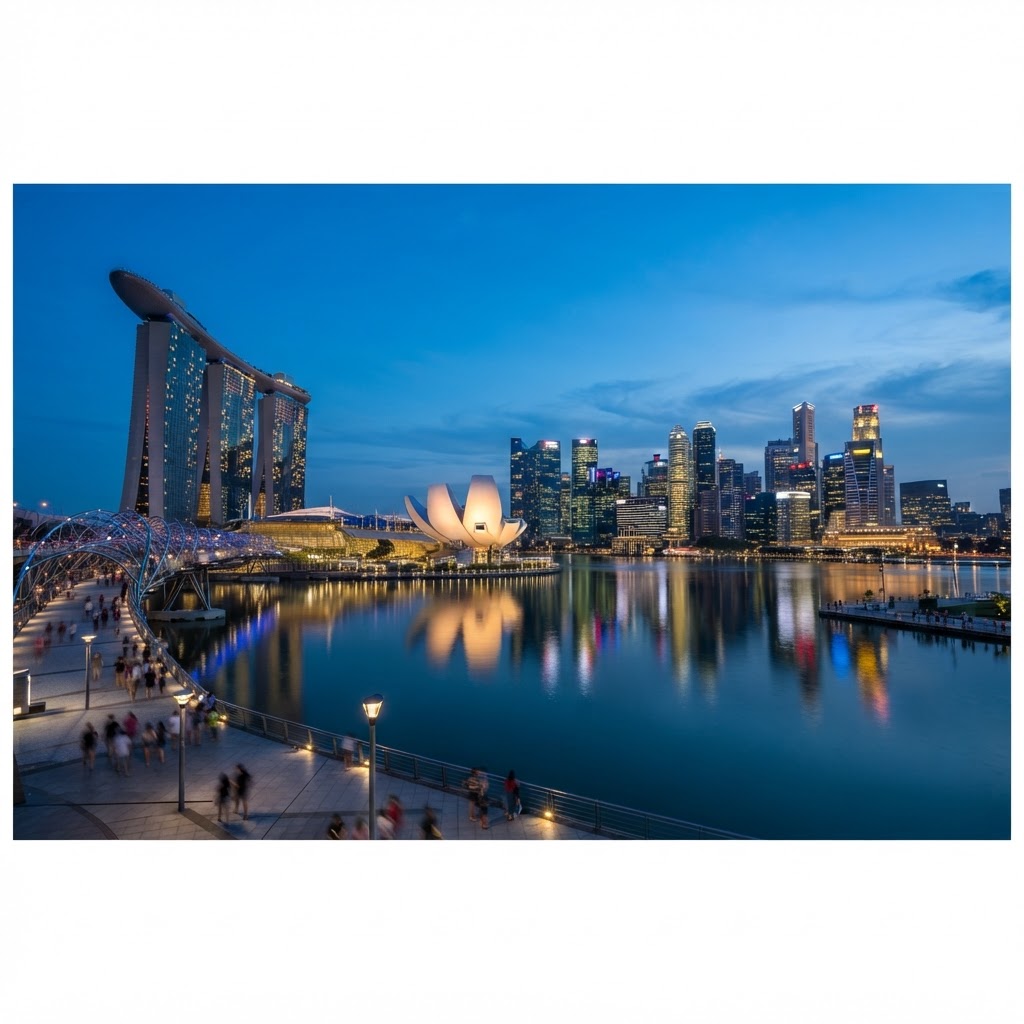
Urban
Marina Bay
An urban reservoir and surrounding district that serves as a modern landmark for the city skyline.

asia
Singapore is an island nation at the southern tip of the Malay Peninsula, shaped by the meeting of sea, city and equatorial weather. Its distinct regions and places—from Marina Bay to Pulau Ubin—reward close attention to how the urban and the natural sit side by side.
The country
The country
At the southern tip of the Malay Peninsula, Singapore is an island nation set between the Straits of Johor to the north and the Singapore Strait to the south. Its position, approximately one degree north of the equator, gives the country a consistently tropical frame: coastal edges, dense urban districts and green spaces all belong to the same compact geography.
Why visit
Singapore is worth approaching as a country of contrasts held close together. Its island position places the sea at the edge of daily life, while its regions and named places reveal a civic landscape that is not reducible to a single skyline. Marina Bay gives the visitor a concentrated view of the modern city; the Singapore Botanic Gardens offer a different register, where cultivated greenery changes the pace of an urban visit. Chinatown and Little India make cultural difference legible through neighbourhood streets and everyday activity, while Merlion Park frames the waterfront as a place of public gathering as well as a recognisable national image. The geography invites movement outward as well as inward. Sentosa Island and Pulau Ubin are part of the country’s island experience, and Gardens by the Bay gives nature a prominent place within the city itself. These are not separate versions of Singapore so much as different ways to read its relationship with land and water. The Central Region and Downtown Core offer a close encounter with the urban centre; the East Region and Changi extend the sense of a country oriented towards its coast and outward connections. A visit can therefore be composed around transitions: from bay to garden, from neighbourhood to waterfront, or from the built-up centre towards an island setting. Singapore suits travellers who value detail, walkable contrasts and the chance to understand a place through the way its geography, public spaces and cultural districts meet.
What it feels like
Equatorial warmth and humidity shape the sensory register: the air is close, rain can interrupt a walk, and a shaded garden or waterfront can feel like a marked change of pace. Around Marina Bay, the city’s composed public face meets the open water; in Chinatown and Little India, neighbourhood life gives the urban fabric a more intimate scale. Gardens by the Bay and the Singapore Botanic Gardens bring cultivated greenery into this close-set landscape.
Who it suits
Singapore suits travellers who enjoy cities with clearly distinct neighbourhoods, public gardens and easy contrasts between the central urban landscape and island settings. It is especially rewarding for visitors willing to plan around tropical heat and rain, and to give time to Marina Bay, Chinatown, Little India, Sentosa Island and Pulau Ubin rather than treating the country as a single city-centre stop.
How to get here
Live fares into Singapore across hundreds of airlines, compared in one search. Book directly with the airline or agent — Makutet never adds a fee.
Live fares to Singapore across hundreds of airlines. Book directly with the airline or agent — no extra cost to you.
Embedded flight search uses TravelPayouts cookies and tracking. Enable partner search to load it here, or continue directly on the partner site.
The external partner link includes Makutet's affiliate marker; confirm your route, dates and passengers there. No booking is made on Makutet.
Live search and booking run on the TravelPayouts partner engine. Fares update in real time and may vary before booking. Any prices shown elsewhere on Makutet are monitored observations, not live quotes.
Identity
The places that define the country rather than merely sit inside it.
Urban
An urban reservoir and surrounding district that serves as a modern landmark for the city skyline.

Nature
A 164-year-old tropical garden located at the fringe of the main shopping district, recognized as a UNESCO World Heritage site.

Cultural
A historical district featuring traditional shophouses and temples that represent the early ethnic Chinese settlements.

Landmark
A landmark located at the waterfront near the city center, featuring a statue of a mythical creature with a lion's head and a fish's body.
Imagery


Discover

Recreation
An island resort located off the southern coast that is connected to the main island by a causeway and cable car system.

Nature
A nature park spanning 101 hectares in the central region, containing waterfront gardens and large climate-controlled conservatories.

Cultural
A vibrant ethnic district known for its colorful shophouses, temples, and markets reflecting the Indian community's heritage.

Nature
An island located to the northeast of the main island that retains a traditional village atmosphere known as a kampung.
Stay
The bases that actually change the trip.

City hotel
Choose a city hotel in the Central Region for straightforward access to the island’s central districts by public transport or taxi. It suits year-round sightseeing, but placing yourself centrally means less time spent crossing the island and generally less immediate access to quieter island landscapes.
first-time visitors · business travellers

Serviced apartment
A serviced apartment in the Downtown Core offers more room and a kitchen-oriented routine while keeping Marina Bay within the central city area. Public transport and taxis make arrival practical; allow extra time for journeys to Pulau Ubin or Sentosa Island, and reserve ahead for periods of high demand.
families · longer-stay travellers

Airport-area accommodation
An airport-area stay in Changi favours early departures and late arrivals over central sightseeing. It is reachable by taxi or public transport, but travelling into Marina Bay or Chinatown adds a cross-island leg; useful in any season when flight timing matters more than being near the centre.
transit travellers · early-flight passengers

Island resort
Staying on Sentosa Island places the coast and island leisure areas close at hand, but makes visits to Chinatown, Little India and the Downtown Core separate journeys. Reach the island from the mainland by local transport or taxi; check access and reserve accommodation ahead, especially for school-holiday and wet-weather travel.
families · coastal-stay travellers
Where to stay
Live rates across Booking.com, Agoda, VRBO and Expedia for Singapore. Compare the areas above, then check what a night actually costs.
Popular destinations
Live rates across Booking.com, Agoda, VRBO and Expedia for Singapore — no extra cost to you.


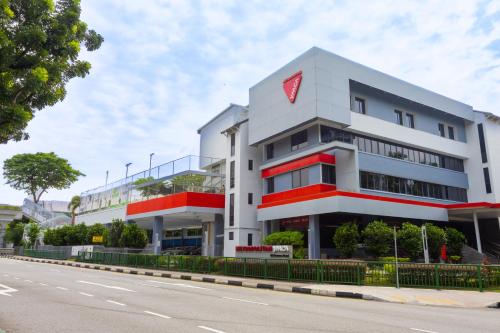

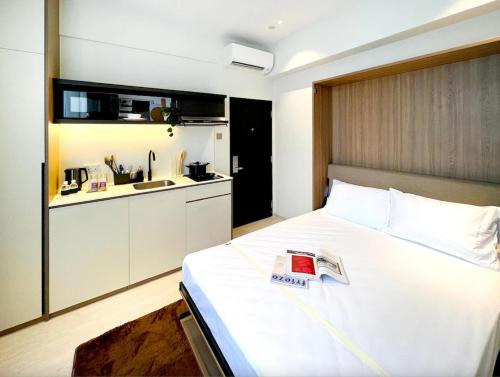


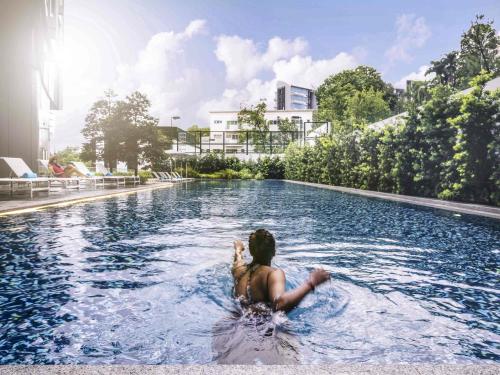
Live rates across our partner network (Booking.com, VRBO, Expedia, Hotels.com) via Stay22. Makutet may earn a commission when you book — at no extra cost to you. Prices update in real time and may vary before booking.
Experience

Guided walking tour
Start at Marina Bay for a guided walk tracing the waterfront, public spaces and modern city architecture. Allow around two to three hours; reserve a guide ahead, particularly during the wetter monsoon periods when sheltered stops matter.
architecture enthusiasts · first-time visitors

Nature and gardens
Join a guided walk through Singapore Botanic Gardens to learn how the garden’s landscapes and planting reflect the island’s tropical conditions. Plan for roughly two hours; book a guide in advance and carry rain protection in any season.
garden lovers · nature travellers

Guided island excursion
Take a guided day from the mainland to Pulau Ubin, where the experience is shaped by island paths and a slower, less urban pace. Set aside most of a day; arrange the guide and boat transfer ahead, and check operating conditions during monsoon weather.
active travellers · wildlife and landscape photographers

Cruise
Board an evening cruise from the Marina Bay waterfront for a measured view of the city from the water. Allow about one to two hours including boarding; reserve a sailing ahead, and have a weather contingency during the wetter monsoon months.
couples · photographers
Things to do
What Makutet's Singapore research recommends, and where the tours that cover it can actually be booked.
Editorial recommendations from Makutet's Singapore research. Tickets and tours are searched on Klook.
Marina Bay walking and architecture tour
Start at Marina Bay for a guided walk tracing the waterfront, public spaces and modern city architecture. Allow around two to three hours; reserve a guide ahead, particularly during the wetter monsoon periods when sheltered stops matter.
Singapore Botanic Gardens guided garden walk
Join a guided walk through Singapore Botanic Gardens to learn how the garden’s landscapes and planting reflect the island’s tropical conditions. Plan for roughly two hours; book a guide in advance and carry rain protection in any season.
Pulau Ubin guided island day
Take a guided day from the mainland to Pulau Ubin, where the experience is shaped by island paths and a slower, less urban pace. Set aside most of a day; arrange the guide and boat transfer ahead, and check operating conditions during monsoon weather.
Marina Bay evening cruise
Board an evening cruise from the Marina Bay waterfront for a measured view of the city from the water. Allow about one to two hours including boarding; reserve a sailing ahead, and have a weather contingency during the wetter monsoon months.
Sentosa Island
An island resort located off the southern coast that is connected to the main island by a causeway and cable car system.
Gardens by the Bay
A nature park spanning 101 hectares in the central region, containing waterfront gardens and large climate-controlled conservatories.
Activity cards are editorial — Makutet is not selling these specific experiences. The partner search opens Klook for Singapore, where availability and price are theirs.
Understand
The context that turns a visit into an understanding.

macro_region
This is the core of the country containing the central business district and many of the densest residential and commercial zones.

macro_region
This region is located on the eastern part of the main island and is home to the primary international airport serving the nation.

sub_region
A planning area serving as the primary commercial and financial hub, situated within the Central Region.

sub_region
An area located in the easternmost part of the country, housing the main international aviation gateway.

Food culture
Hawker-centre dining is part of everyday Singapore life: choose a stall, order at its counter and find a shared table, often identified by a tissue packet or other small marker. Go at meal times for the fullest choice, and carry some cash because not every stall handles payment in the same way.

Local dish
Chilli crab is a well-known Singapore seafood dish, typically served as a shared meal with a rich, spicy-sweet sauce. It is a sit-down choice rather than a quick snack; ask about the serving size and spice level when ordering, and expect to use your hands or utensils for the crab.

Breakfast and drink
Kaya toast with kopi is a familiar Singapore breakfast pairing: toasted bread with coconut-and-egg kaya, often accompanied by coffee prepared in a local style. It works well as a simple morning stop before walking around Chinatown or the Downtown Core.

Neighbourhood culture
Chinatown is a living neighbourhood as well as a heritage district, with everyday commerce and places of worship alongside visitor routes. Explore on foot, dress respectfully when entering religious spaces, and allow time to move between its streets rather than treating it as a single photo stop.

Traditions and district life
Little India’s shops, religious life and festival activity give the district a distinct rhythm within Singapore. Walk at an unhurried pace, respect customs at places of worship, and expect busier streets when religious or cultural events are under way.
When to go
February–April
A useful shoulder period
Warm days with a generally drier feel
June–September
Hot and changeable
Plan shade into the day
November–January
Wetter season
Expect heavier rain
Practical
Money, transport, connectivity and the details that matter on the ground.
Budget
Singapore uses the Singapore dollar. Cards are widely useful in hotels, larger shops and many restaurants, while cash remains practical for some hawker stalls and small vendors; ask before ordering. Spending tends to rise with central and Marina Bay accommodation and resort stays on Sentosa Island, while transport and meals can be managed more modestly by choosing local options.
Transport
Public transport connects the Central Region, Downtown Core, Changi and the eastern and western parts of the island; taxis and ride-hailing are useful when carrying luggage or travelling late. Singapore drives on the left. Pulau Ubin and Sentosa Island require an additional island-access leg, so allow time for the transfer rather than treating them as ordinary cross-town stops.
Safety
Singapore is generally orderly, but take ordinary care with valuables in busy areas such as Chinatown and Marina Bay. The emergency number for police is 999 and for ambulance or fire services is 995. Tap water is safe to drink; tipping is not customary, though rounding up or a small discretionary amount may be appreciated in some settings.
Connectivity
Mobile coverage is strong across the urban island, with local SIMs and eSIMs available for visitors; check device compatibility before arrival. Singapore uses Type G power sockets, so bring a suitable adaptor. Wi-Fi is common in accommodation and many public venues, but do not assume every small food stall offers a connection.
Seasonal weather
Singapore is hot, humid and tropical throughout the year. The wetter monsoon periods, particularly the northeast monsoon from December to early March and the southwest monsoon from June to September, bring heavier rain and thunderstorms that can interrupt outdoor plans; short showers also occur outside those periods. Keep a flexible plan for Pulau Ubin, Sentosa Island and open-air walks around Marina Bay, and carry light rain protection year-round.
Accessibility and mobility
Singapore’s central urban areas generally have extensive step-free public transport and modern pavements, but kerbs, crowded footpaths and sudden tropical downpours can complicate wheelchair or pushchair journeys. Older buildings and smaller accommodation properties may have limited lift or bathroom access, so confirm room and entrance details directly before booking. Island paths at Pulau Ubin are less even than city routes; plan a separate mobility check before going.
Getting around
Airport transfers, rail, buses, ferries and car hire for Singapore — arranged before you fly, priced by the supplier.
Stay connected
Install an eSIM before you fly and you are online the moment you land in Singapore — no roaming charges, no shop queue at the airport.
Moments
Singapore is best read through its transitions: from the water’s edge into the Downtown Core, from a neighbourhood street into a garden, and from the urban centre towards islands such as Sentosa Island and Pulau Ubin. The country’s character lies not in a single view, but in how these different settings share one small island nation.
The signature moment
At Marina Bay, pause as the light begins to soften over the water. The surface holds the changing colours of the sky, while the city’s outline gathers at the edge of the bay; footsteps and conversation move around the public waterfront, and the open air gives relief from the day’s equatorial warmth. A breeze can make the humid air feel briefly lighter. There is no need to rush from one viewpoint to another: stay long enough to see the same buildings shift from crisp forms into reflections and silhouettes. The scene is distinctly Singaporean because it keeps several truths in view at once. This is a country defined by its island position, yet the bay is also a carefully shaped urban space; the water feels open, while the city around it is concentrated and deliberate. From here, the Singapore Botanic Gardens, Chinatown and Little India are not competing versions of the country but different ways to encounter it. The moment at the water’s edge makes that closeness palpable: sea, civic life and the wider city share a single frame.
The story behind it
Singapore’s heritage is shaped by its strategic position at the southern end of the Malay Peninsula, between the Straits of Johor and the Singapore Strait. Its history should be understood as more than a story of modern urban development: the island’s location has long made movement, exchange and political change central to its experience. The present-day country contains distinct cultural districts, including Chinatown and Little India, alongside a modern civic centre around Marina Bay and the Downtown Core. These layers coexist rather than forming a simple, uninterrupted narrative of progress. A careful visit can notice how public spaces and neighbourhoods represent different parts of the country’s past and present, while recognising that the history of a trading and urban society also includes difficult questions of power, identity and change.
Before you go
Singapore rewards a measured pace. Give the central city and its neighbourhoods time to speak in different registers, then make room for the contrast of Sentosa Island or Pulau Ubin. The change of setting is part of the country’s story, not a diversion from it. Leave space in the day for heat, rain and a pause beneath greenery. A visit shaped by those small adjustments can reveal more than a schedule built around landmarks alone: it lets the island’s relationship between urban life, gardens and water come into focus.
Equatorial position
Singapore lies approximately one degree north of the equator, a geographic fact that helps explain its tropical warmth and the importance of shade and rain-aware planning.
Island setting
Singapore is separated from the Malay Peninsula by the Straits of Johor and from Indonesia by the Singapore Strait; its national geography is maritime rather than defined by land borders.
December–February
A comparatively drier spell
These months are commonly among Singapore’s comparatively drier periods, making longer walks between Marina Bay, Chinatown and the Singapore Botanic Gardens easier to plan, though tropical showers remain possible.
June–September
Hot, changeable days
Expect persistent equatorial warmth and the possibility of showers. Shape outings around shaded stops, including the Singapore Botanic Gardens, and leave flexibility when travelling between the Central Region and island settings.
November–January
Wetter monsoon period
The north-east monsoon brings a wetter period, with heavier and more frequent rain. Keep outdoor plans flexible, allow time for downpours, and avoid relying on an uninterrupted day outside at Pulau Ubin or Sentosa Island.
FAQ
It is hot and humid year-round, with heavier rain and thunderstorms during the monsoon periods, especially December to early March and June to September.
Travel from the mainland to the island by boat; allow time for that transfer and check conditions before setting out in wet weather.
Yes. Tap water is safe to drink, so a reusable bottle is useful while walking around the island.
Singapore uses the Singapore dollar. Cards are widely accepted, but keep some cash for hawker stalls and smaller vendors.
Tipping is not customary. A small discretionary amount may be appreciated in some situations, but it is not generally expected.
Yes. Public transport serves the Central Region, Downtown Core and Changi; Sentosa Island and Pulau Ubin involve an additional island-access leg.
Singapore uses Type G sockets. Check your devices and bring a compatible adaptor.
Before you go
The last thing most travellers forget — and the disclosure that applies to every partner link on this page.
Booking and rate checks run on the partner's own site; prices and availability are theirs and can change. Some links are affiliate links and Makutet may earn a commission at no extra cost to you. See our affiliate disclosure.
Destinations
1 published destination
Makutet builds a day-by-day itinerary around the places above — then keeps it updated as you travel.
Country guide: /country/singapore
Your assessment works without optional tracking. Necessary storage keeps your trip and privacy choice. Embedded flight search includes TravelPayouts tracking; ordinary partner links remain available if you decline.
Cookie policy · Privacy policy. Reopen Cookie settings to change your choice. Supplier-site cookies are controlled by that supplier.