
urban
Nouakchott
The capital and largest city, serving as the administrative and economic hub located along the Atlantic coastline.

africa
Mauritania is shaped by the meeting of the Atlantic and the Sahara, with the Adrar Plateau and Senegal River Valley marking different scales of its interior. Here, distance is part of the country’s character, not merely the space between places.
The country
The country
Mauritania occupies a meeting ground between the Maghreb and West Africa, with the Atlantic along its western edge and the Sahara shaping much of its interior. Its geography is not a backdrop but the organising fact of travel: coast, desert, plateau and river valley each give the country a distinct scale and character.
Why visit
Mauritania is best understood through contrasts that remain connected by its immense geography. The Atlantic coast gives way to the Sahara Desert Zone; inland, the Adrar Plateau and the Trarza Region offer different expressions of the arid landscape, while the Senegal River Valley marks a greener southern edge. Travelling here means encountering not a single desert scene but a country shaped by the meeting of coast, sand, rock and river. That variety is legible in its named places. Nouakchott gives an urban point of orientation on the Atlantic side. Chinguetti and Ouadane place the traveller among settlements associated with the desert interior, while the Richat Structure and Terjit draw attention to the scale and forms of the landscape. At Banc d'Arguin National Park and Diawling National Park, the story turns towards coastal and riverine environments. These places are not interchangeable stops: together they suggest how sharply Mauritania’s settings can change, and why distances and transitions matter as much as individual sights. A visit suits someone willing to plan around geography rather than expect a compact circuit. The country borders Algeria, Mali and Senegal, yet its character is also defined by its Atlantic frontage and by the broad reach of the Sahara. A thoughtful itinerary allows time for the passage between regions and treats the journey itself as part of the experience. Mauritania rewards attention to landscape, settlement and scale; it is a place to approach with curiosity and practical preparation, not a checklist.
What it feels like
The atmosphere shifts with the terrain: Atlantic air on the western edge, open desert horizons across the Sahara Desert Zone, and a more river-shaped landscape in the Senegal River Valley. Around the Adrar Plateau, rock and arid expanses give the interior a different texture from the coast. The result is a country of pronounced distances and quiet transitions, where the landscape often sets the pace.
Who it suits
Mauritania suits independent-minded travellers who value geography, cultural context and unhurried observation. It is particularly fitting for those prepared to plan carefully for long distances and changing terrain, and who would rather understand the relationship between Nouakchott, the desert interior and the Senegal River Valley than rush through a list of stops.
How to get here
Live fares into Mauritania across hundreds of airlines, compared in one search. Book directly with the airline or agent — Makutet never adds a fee.
Live fares to Mauritania across hundreds of airlines. Book directly with the airline or agent — no extra cost to you.
Embedded flight search uses TravelPayouts cookies and tracking. Enable partner search to load it here, or continue directly on the partner site.
The external partner link includes Makutet's affiliate marker; confirm your route, dates and passengers there. No booking is made on Makutet.
Live search and booking run on the TravelPayouts partner engine. Fares update in real time and may vary before booking. Any prices shown elsewhere on Makutet are monitored observations, not live quotes.
Identity
The places that define the country rather than merely sit inside it.
urban
The capital and largest city, serving as the administrative and economic hub located along the Atlantic coastline.

heritage
A historic medieval trading center and UNESCO World Heritage site known for its ancient manuscript libraries.

park
A coastal national park featuring extensive mudflats and shallow waters, recognized as a vital site for migratory bird species.

heritage
An ancient fortified desert town that historically flourished as a waypoint for trans-Saharan caravan trade routes.
Imagery


Discover

geology
A prominent circular geological feature, also known as the Eye of the Sahara, visible from space due to its unique concentric rings.

culture
An oasis town situated on the Tagant Plateau, noted for its traditional mud-brick architecture and surrounding palm groves.

wildlife
Located in the Senegal River delta, this park preserves a diverse aquatic ecosystem consisting of lagoons and mangrove forests.

nature
A scenic desert oasis featuring natural springs and palm trees, nestled within a deep rocky canyon in the Adrar region.
Stay
The bases that actually change the trip.

Guesthouse
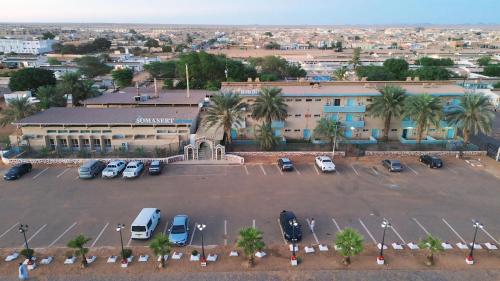
A guesthouse in Nouakchott offers the most practical base for arranging onward transport between the Atlantic-facing capital and the interior. It suits arrivals and departures that need services close at hand; confirm transfers and room availability before arrival, particularly if continuing overland to the Adrar Plateau.
independent travellers · first-time visitors

Desert guesthouse
Staying in Chinguetti places you within the Sahara Desert Zone and makes an early start for a guided drive more practical than a day visit from Nouakchott. Reach it as part of a pre-arranged overland itinerary, allow for the long inland journey, and reserve both lodging and transport ahead; cooler-season travel is more comfortable for time outdoors.
desert travellers · heritage-minded visitors

Regional guesthouse
A simple guesthouse in Ouadane works best as part of a planned Adrar Plateau circuit rather than a spontaneous stop. Reaching the town requires an arranged inland drive, and choosing this base means allowing time for remote road access and coordinating accommodation with a guide and vehicle before setting out.
overland travellers · independent explorers

Nature camp
A basic camp arranged near the Banc d’Arguin National Park offers a coastal, nature-focused stay rather than the services of a city base. Access and supplies require advance coordination with a specialist operator; ask specifically about transport, drinking water, facilities and the season of operation before committing to the remote stay.
birdwatchers · remote-area travellers
Where to stay
Live rates across Booking.com, Agoda, VRBO and Expedia for Mauritania. Compare the areas above, then check what a night actually costs.
Popular destinations
Live rates across Booking.com, Agoda, VRBO and Expedia for Mauritania — no extra cost to you.



Live rates across our partner network (Booking.com, VRBO, Expedia, Hotels.com) via Stay22. Makutet may earn a commission when you book — at no extra cost to you. Prices update in real time and may vary before booking.
Experience

Guided desert drive
Set out from Chinguetti with a locally arranged guide and vehicle for a full day among the surrounding Sahara Desert Zone. Confirm the route, overnight arrangements if required, and a suitable cooler-season departure directly with the operator well ahead; this is an overland trip, not a walk-in excursion.
overland travellers · landscape photographers
Coastal nature excursion
Arrange a guided day from the Banc d’Arguin National Park area to experience its Atlantic coast and wildlife habitat. Access depends on local transport and conditions, so agree the departure point, vehicle or boat arrangements, duration and season with a specialist operator before travelling; advance planning is essential.
wildlife watchers · nature travellers

Multi-day overland journey
Take a multi-day guided drive through the Adrar Plateau, using Chinguetti and Ouadane as named anchors for an interior itinerary. Long road sections and remote access make a suitable vehicle, guide, supplies and overnight plan important; reserve these arrangements in advance and favour the cooler part of the year.
adventure travellers · cultural explorers

Guided regional day
Use the Senegal River Valley as the setting for a guided day focused on the landscape and communities of Mauritania’s southern river corridor. Arrange transport and a local guide ahead, and check the current seasonal conditions and route; the day’s length depends on the chosen starting point and road access.
slow travellers · cultural observers
Things to do
What Makutet's Mauritania research recommends, and where the tours that cover it can actually be booked.
Editorial recommendations from Makutet's Mauritania research. Tickets and tours are searched on GetYourGuide.
Guided Sahara traverse from Chinguetti
Set out from Chinguetti with a locally arranged guide and vehicle for a full day among the surrounding Sahara Desert Zone. Confirm the route, overnight arrangements if required, and a suitable cooler-season departure directly with the operator well ahead; this is an overland trip, not a walk-in excursion.
Banc d’Arguin coastal wildlife outing
Arrange a guided day from the Banc d’Arguin National Park area to experience its Atlantic coast and wildlife habitat. Access depends on local transport and conditions, so agree the departure point, vehicle or boat arrangements, duration and season with a specialist operator before travelling; advance planning is essential.
Adrar Plateau guided road journey
Take a multi-day guided drive through the Adrar Plateau, using Chinguetti and Ouadane as named anchors for an interior itinerary. Long road sections and remote access make a suitable vehicle, guide, supplies and overnight plan important; reserve these arrangements in advance and favour the cooler part of the year.
Senegal River Valley guided day
Use the Senegal River Valley as the setting for a guided day focused on the landscape and communities of Mauritania’s southern river corridor. Arrange transport and a local guide ahead, and check the current seasonal conditions and route; the day’s length depends on the chosen starting point and road access.
Richat Structure
A prominent circular geological feature, also known as the Eye of the Sahara, visible from space due to its unique concentric rings.
Tidjikja
An oasis town situated on the Tagant Plateau, noted for its traditional mud-brick architecture and surrounding palm groves.
Activity cards are editorial — Makutet is not selling these specific experiences. The partner search opens GetYourGuide for Mauritania, where availability and price are theirs.
Understand
The context that turns a visit into an understanding.

macro_region
This vast arid region covers the northern and eastern two-thirds of the country, characterized by shifting sand dunes and rocky plateaus.

macro_region
Situated in the extreme south along the border with Senegal, this area features the country's most fertile agricultural land and floodplains.

sub_region
A rugged, elevated area in the central desert known for its ancient desert settlements and dramatic sandstone cliffs.

sub_region
Located in the southwestern part of the country, this administrative region connects the coastal capital area to the Senegal River basin.

Hospitality custom
Tea hospitality is part of everyday social life in Mauritania. When invited to share it, allow time to sit and participate rather than treating the serving as a quick refreshment; in Nouakchott and on journeys through the Adrar Plateau, it can be a natural pause in conversation.

Food culture
Mauritanian food reflects both an arid interior and an Atlantic coast. Ask locally what is available rather than assuming a uniform menu between Nouakchott, the Sahara Desert Zone and the Senegal River Valley; where fish is offered, the coastal setting makes it a particularly relevant choice.

Social etiquette
Dress modestly and greet people respectfully in Nouakchott, Chinguetti and smaller communities alike. In a conservative social setting, ask before photographing people and follow a host’s lead around private or religious spaces; these courtesies matter as much on an organised visit as on a town walk.

Nature and place character
The coast at Banc d’Arguin National Park is known for its birdlife and marine setting, a different experience from the inland Sahara Desert Zone. Go with locally arranged access, keep a respectful distance from wildlife and follow the guide’s instructions about routes and sensitive coastal areas.
When to go
November–February
Cool season
The clearest general window for inland journeys
March–May
Warming shoulder
Workable with a more measured pace
June–October
Hot season
More demanding for exposed travel
Practical
Money, transport, connectivity and the details that matter on the ground.
Budget
Mauritania’s currency is the ouguiya. Carry cash for everyday purchases and services, especially beyond Nouakchott and in the Sahara Desert Zone; do not assume card payment will be available. A trip’s main costs are likely to be transport across long distances, a suitable vehicle and guide for interior travel, and accommodation. Remote journeys and travel in the cooler dry season can require more logistical planning and support than a stay in Nouakchott or the Senegal River Valley. Confirm payment methods and what is included before booking.
Transport
Nouakchott is the practical starting point for travel between the Atlantic coast and the interior, but journeys to the Adrar Plateau, Chinguetti or Ouadane involve long overland distances. Arrange a suitable vehicle and local guidance in advance for remote routes; do not treat them as ordinary city transfers. The Senegal River Valley is a distinct southern travel area, while reaching Banc d'Arguin National Park also needs advance transport planning. Mauritania drives on the right; confirm current road conditions before setting out.
Safety
Distances between settled areas can be substantial, particularly on routes into the Sahara Desert Zone and the Adrar Plateau. Plan remote travel with an experienced local driver or guide, carry water and supplies, and share your route and expected arrival with someone. Check current local advice and road conditions before travelling, and keep a flexible schedule for overland journeys. For emergencies, verify the appropriate contact details locally rather than relying on an assumed universal number.
Connectivity
Mobile coverage and reliable data are easiest to arrange in Nouakchott; do not count on a continuous connection on journeys towards Chinguetti, Ouadane or the Sahara Desert Zone. Download essential maps and keep accommodation and transport details available offline before leaving town. An eSIM or local SIM may help where service is available, but neither replaces a plan for communication during remote travel.
Seasonal weather
Mauritania’s climate is predominantly hot and arid, with the Sahara Desert Zone especially exposed to heat and dust. The cooler, drier months from roughly November to February are generally more comfortable for overland travel to the Adrar Plateau, Chinguetti and Ouadane. Summer heat makes long inland drives more demanding; the Senegal River Valley has a stronger seasonal rainfall pattern, so check conditions before planning southern travel. Coastal conditions around Nouakchott and Banc d'Arguin National Park can feel different from the interior.
Accessibility and mobility
Travellers with reduced mobility, wheelchair users, pushchairs and older companions should expect significant practical obstacles. Long overland routes, sandy or uneven ground around the Sahara Desert Zone and Adrar Plateau, and limited paved pedestrian surfaces make independent movement difficult outside Nouakchott. Vehicle access and accommodation facilities should be checked directly before booking; do not assume step-free rooms, accessible bathrooms or adapted transport. A private vehicle, assistance and a carefully limited itinerary can make some city-based visits more manageable, but remote sites may remain inaccessible.
Getting around
Airport transfers, rail, buses, ferries and car hire for Mauritania — arranged before you fly, priced by the supplier.
Stay connected
Install an eSIM before you fly and you are online the moment you land in Mauritania — no roaming charges, no shop queue at the airport.
Moments
Mauritania is shaped by the meeting of Atlantic coast, Sahara and the Senegal River Valley. Its distances are part of the experience: the open shore gives way to desert regions and plateaux, while towns such as Chinguetti and Ouadane hold a different rhythm from Nouakchott. This is a country best read through its landscapes and the transitions between them, rather than through a single itinerary or city.
The signature moment
At Terjit, let the pace of the day settle before trying to name what makes the place distinctive. The Adrar Plateau belongs to a country often imagined as nothing but vast open desert, yet here the encounter is more intimate: the desert’s scale is present around you, while the immediate surroundings draw attention to shade, stone and the small changes in air against the heat. Listen for the difference between a sheltered pause and the exposed quiet beyond it; notice how the ground feels underfoot and how welcome a moment out of direct sun can be. There is no need to turn the scene into a checklist. Stay long enough for the contrast to register. Terjit gathers Mauritania’s defining tensions into one experience: immense Sahara, close human scale, and the physical importance of finding shelter in a dry landscape. From there, the country opens outward again—to the Atlantic, the Senegal River Valley and the long distances connecting its regions.
The story behind it
Mauritania’s heritage sits at the meeting of Saharan routes, settled communities and the Senegal River Valley. Chinguetti and Ouadane are among the country’s identity places, while the Adrar Plateau and the Sahara Desert Zone give that inheritance a striking physical setting. The country’s geography also faces the Atlantic and reaches south towards the Senegal River. A neutral account must hold these distinct environments together without reducing Mauritania to either desert or coast: its regional character is varied, and its history is not captured by one landscape or one town.
Before you go
A journey through Mauritania asks for attention to transitions: from Nouakchott towards the interior, from the Atlantic edge into the Sahara Desert Zone, or from the Adrar Plateau towards the Senegal River Valley. The route matters as much as the stop, and room in the itinerary allows the landscape to change at its own pace. Carry that sense of scale with you. Chinguetti, Ouadane, Terjit and the coast are not interchangeable impressions, but distinct ways of encountering a country whose geography holds desert, river and ocean together.
Three landscapes meet
Mauritania faces the Atlantic while encompassing the Sahara Desert Zone and the Senegal River Valley, so its national character cannot be understood through desert alone.
A broad regional canvas
The Adrar Plateau and Trarza Region are among Mauritania’s recorded geographic regions, alongside the Sahara Desert Zone and Senegal River Valley.
November–February
Cooler desert season
These cooler months are generally the most comfortable window for exploring the Sahara Desert Zone, the Adrar Plateau and inland places such as Chinguetti and Ouadane. Plan transfers between regions with care; distances remain a central part of the journey.
March–May
Warm shoulder season
Conditions become warmer as the year advances, making exposed inland travel more demanding. Keep the day’s plans measured, allow time for rest and shade, and consider balancing desert routes with time in Nouakchott or along the Atlantic coast.
June–October
Hot, humid season
The hot season brings greater heat, and the period is also associated with rainfall, especially towards the south. Treat long overland journeys and exposed visits as more challenging; confirm local conditions and transport arrangements before setting out.
FAQ
The cooler, drier months from roughly November to February are generally more comfortable for inland overland travel; summer heat makes desert journeys more demanding.
Yes. Journeys from Nouakchott towards the Adrar Plateau, Chinguetti or Ouadane cover remote terrain and should be arranged with a suitable vehicle and local guidance.
No. Carry cash in ouguiya, particularly outside Nouakchott, and confirm payment options with accommodation and transport providers before travelling.
Coverage should not be assumed on routes into the Sahara Desert Zone or towards Chinguetti and Ouadane. Save maps and key travel details offline before leaving Nouakchott.
It can be difficult: sandy and uneven terrain, limited paved pedestrian access outside Nouakchott and unconfirmed accommodation facilities require careful checks and assistance planning.
The Senegal River Valley has a stronger seasonal rainfall pattern than the arid interior. Check conditions before planning southern travel, particularly during the rainy season.
Before you go
The last thing most travellers forget — and the disclosure that applies to every partner link on this page.
Booking and rate checks run on the partner's own site; prices and availability are theirs and can change. Some links are affiliate links and Makutet may earn a commission at no extra cost to you. See our affiliate disclosure.
Makutet builds a day-by-day itinerary around the places above — then keeps it updated as you travel.
Country guide: /country/mauritania
Your assessment works without optional tracking. Necessary storage keeps your trip and privacy choice. Embedded flight search includes TravelPayouts tracking; ordinary partner links remain available if you decline.
Cookie policy · Privacy policy. Reopen Cookie settings to change your choice. Supplier-site cookies are controlled by that supplier.