Historical Site
Prague Castle
A large castle complex dating back to the 9th century that serves as the official office of the President of the Czech Republic.

europe
Landlocked at the heart of Central Europe, the Czech Republic is shaped by Bohemia and Moravia. Its castles, historic squares and varied landscapes give the country a distinct sense of place.
The country
The country
Landlocked in Central Europe, the Czech Republic sits between Germany, Poland, Slovakia and Austria. Bohemia and Moravia give its geography a regional character, while Prague Castle, Charles Bridge and Old Town Square offer a concentrated introduction to its historic identity. Beyond the capital, Cesky Krumlov, Karlovy Vary, Brno and Bohemian Switzerland National Park point towards a country best understood through both its cities and its landscapes.
Why visit
The Czech Republic rewards a traveller who is willing to look beyond a single city without losing sight of the historical layers that make its cities compelling. Prague’s defining places—Prague Castle, Charles Bridge and Old Town Square—place architecture and public life in close conversation. Yet the country’s character does not end at the capital. Bohemia and Moravia are distinct regional frames for a journey through a landlocked Central European landscape, and the named places beyond Prague suggest very different ways of encountering it: Cesky Krumlov for the impression of a historic town, Brno for an urban counterpoint, Karlovy Vary for a spa-town tradition, Karlstejn Castle for a strong architectural landmark, and Bohemian Switzerland National Park for a turn towards nature. The geography makes these contrasts especially legible: the country occupies a central position, bordered by Germany, Poland, Slovakia and Austria, but its identity is not simply a passage between neighbours. It has a clear interior focus, shaped by regions rather than coastlines. A satisfying itinerary can therefore move from the concentrated streets and squares of Prague towards the quieter distinctions of Bohemia and Moravia, allowing each place to alter the sense of scale. This is a country for travellers who enjoy history as something encountered in streets, buildings and regional contrasts, not only in formal collections; for those who welcome a change from urban heritage to open landscape; and for anyone content to let a relatively compact set of places tell a layered story. Its appeal lies in that measured variety: a central European setting, a strong historic presence and a journey that can remain grounded in named places rather than grand claims.
What it feels like
In Prague, the historic presence is immediate in the spaces around Prague Castle, Charles Bridge and Old Town Square. Elsewhere, the mood shifts with the landscape and region: the wooded formations of Bohemian Switzerland National Park suggest an outdoor register, while Karlovy Vary carries the character of a spa town. Bohemia and Moravia make the journey feel regional rather than uniform.
Who it suits
The Czech Republic suits travellers drawn to historic urban settings who also want to make room for regional variety and nature. It is a good fit for an itinerary that combines Prague’s landmark places with Cesky Krumlov, Brno, Karlovy Vary, Karlstejn Castle or Bohemian Switzerland National Park, rather than treating the country as a single-city visit.
How to get here
Live fares into Czech Republic across hundreds of airlines, compared in one search. Book directly with the airline or agent — Makutet never adds a fee.
Live fares to Czech Republic across hundreds of airlines. Book directly with the airline or agent — no extra cost to you.
Embedded flight search uses TravelPayouts cookies and tracking. Enable partner search to load it here, or continue directly on the partner site.
The external partner link includes Makutet's affiliate marker; confirm your route, dates and passengers there. No booking is made on Makutet.
Live search and booking run on the TravelPayouts partner engine. Fares update in real time and may vary before booking. Any prices shown elsewhere on Makutet are monitored observations, not live quotes.
Identity
The places that define the country rather than merely sit inside it.
Historical Site
A large castle complex dating back to the 9th century that serves as the official office of the President of the Czech Republic.

Infrastructure
A historic stone Gothic bridge that crosses the Vltava River in Prague, connecting the Old Town with the Lesser Town.

City Square
The historic square in the Old Town quarter of Prague featuring the medieval Astronomical Clock and various architectural styles.

Urban Center
A small city in the South Bohemian Region famous for its well-preserved medieval architecture and a large castle overlooking the Vltava River.
Imagery


Discover

National Park
A protected landscape area near the German border known for its sandstone rock formations, arches, and deep canyons.

Spa Town
A spa town located in western Bohemia, famous for its numerous hot springs and annual international film festival.

Urban Center
The second-largest city in the country, serving as the judicial and administrative center of the Moravia region.

Historical Castle
A high Gothic castle founded in 1348 by Charles IV, situated on a hill above the Berounka River southwest of Prague.
Stay
The bases that actually change the trip.

Guesthouse
Staying in Prague makes Charles Bridge and Old Town Square accessible on foot or by local transport, while the city is a practical base in every season. Expect busy streets and longer walking distances around historic areas; choose accommodation with step-free access confirmed directly.
city explorers · independent travellers

Rural guesthouse
A Bohemia guesthouse suits travellers planning walks and countryside visits, but reaching it may require a rail or bus connection followed by local transport. Spring through autumn favours outdoor days; check the final approach and public-transport frequency before booking.
walkers · slow travellers

Apartment
Use Brno as an urban base for exploring Moravia, with city services close by and regional journeys planned from town. It works through the year; an apartment offers more self-catering flexibility, though guests should confirm stairs, lift access and arrival arrangements.
longer-stay travellers · self-catering visitors

Spa accommodation
Choose accommodation in Karlovy Vary for a stay centred on the town’s spa character rather than a countryside base. It is suitable year-round; check how far the lodging is from the places you plan to visit, since slopes and walking can shape daily access.
rest-focused travellers · older visitors
Where to stay
Live rates across Booking.com, Agoda, VRBO and Expedia for Czech Republic. Compare the areas above, then check what a night actually costs.
Popular destinations
Live rates across Booking.com, Agoda, VRBO and Expedia for Czech Republic — no extra cost to you.


Live rates across our partner network (Booking.com, VRBO, Expedia, Hotels.com) via Stay22. Makutet may earn a commission when you book — at no extra cost to you. Prices update in real time and may vary before booking.
Experience

Guided walking tour
Start at Old Town Square for a guided walk towards Charles Bridge, allowing about half a day. Walking tours operate through the year; reserve a guide ahead, particularly for peak summer and holiday periods.
first-time visitors · architecture enthusiasts

Guided hiking
Use Bohemian Switzerland National Park as the starting point for a guided day walk, with the route and duration agreed to suit conditions and ability. Spring to autumn is the practical walking season; arrange a guide and transport in advance.
active travellers · nature lovers

Guided town walk
Explore Karlovy Vary on a guided town walk, setting aside several hours to understand its spa-town character and architecture. Visits are possible year-round; reserve a guide ahead if you need a particular language or time.
culture-minded travellers · slow travellers

Guided day trip
Make Karlstejn Castle the focus of a guided day out, allowing time for the journey, the castle visit and the surrounding landscape. Check visiting arrangements and reserve any guided entry ahead, especially during the warmer months.
history enthusiasts · families
Things to do
What Makutet's Czech Republic research recommends, and where the tours that cover it can actually be booked.
Editorial recommendations from Makutet's Czech Republic research. Tickets and tours are searched on GetYourGuide.
Guided walk through Prague’s historic centre
Start at Old Town Square for a guided walk towards Charles Bridge, allowing about half a day. Walking tours operate through the year; reserve a guide ahead, particularly for peak summer and holiday periods.
Day walk in Bohemian Switzerland National Park
Use Bohemian Switzerland National Park as the starting point for a guided day walk, with the route and duration agreed to suit conditions and ability. Spring to autumn is the practical walking season; arrange a guide and transport in advance.
Guided visit to Karlovy Vary
Explore Karlovy Vary on a guided town walk, setting aside several hours to understand its spa-town character and architecture. Visits are possible year-round; reserve a guide ahead if you need a particular language or time.
Day trip to Karlstejn Castle
Make Karlstejn Castle the focus of a guided day out, allowing time for the journey, the castle visit and the surrounding landscape. Check visiting arrangements and reserve any guided entry ahead, especially during the warmer months.
Bohemian Switzerland National Park
A protected landscape area near the German border known for its sandstone rock formations, arches, and deep canyons.
Karlovy Vary
A spa town located in western Bohemia, famous for its numerous hot springs and annual international film festival.
Activity cards are editorial — Makutet is not selling these specific experiences. The partner search opens GetYourGuide for Czech Republic, where availability and price are theirs.
Understand
The context that turns a visit into an understanding.

macro_region
The western historical region of the Czech Republic, characterized by a basin surrounded by low mountain ranges including the Sudetes and the Bohemian Forest.

macro_region
The eastern historical region of the country, known for its diverse landscapes ranging from rolling hills and vineyards to the rugged terrain of the Carpathian Mountains.

sub_region
The region surrounding the capital city, featuring a mix of agricultural lowlands and historical settlements along the Vltava and Labe rivers.

sub_region
A region known for its fertile lowlands, viticulture, and proximity to the border with Austria and Slovakia.

Drink culture
Beer is part of everyday hospitality in Czech Republic. In Prague, ask for the house beer in a pub and note that a hospoda is as much a social meeting place as a place to eat.

Food
This Czech dish of beef with a creamy root-vegetable sauce is commonly served with bread dumplings. It is a substantial meal to seek out in Prague or Brno rather than a light option between walks.

Wine tradition
Moravia is associated with wine-growing and wine drinking, offering a different local table experience from the beer-led pub culture. Brno provides a convenient city base for asking about regional wines and Moravian varieties.

Urban character
Old Town Square and the lanes around it concentrate historic architecture and visitor activity. Visit early or later in the day for a less compressed walk, and expect uneven paving that can slow wheelchairs and pushchairs.

Custom
Name days are recognised in Czech social life alongside birthdays. If invited to a local gathering, a modest greeting or small token is a considerate gesture; follow the host’s lead rather than assuming a formal celebration.
When to go
April–June
Spring to early summer
Mild conditions for city and countryside
July–August
High summer
Warm days, busier urban places
September–October
Early autumn
Cooler weather for a varied itinerary
December–February
Winter
Cold weather and shorter days
Practical
Money, transport, connectivity and the details that matter on the ground.
Budget
Czech Republic uses the Czech koruna. Cards are widely useful in cities, but keep some cash for smaller businesses and rural stops; ask before paying in a different currency. Spending tends to concentrate in Prague and in peak visitor periods, while transport, meals and access to countryside regions such as Bohemia require separate planning.
Transport
Rail and bus journeys connect major cities such as Prague and Brno, while smaller places and countryside routes may need careful timetable planning or a car. Drive on the right. For Karlstejn Castle or Bohemian Switzerland National Park, check the last leg from the nearest transport stop before setting out.
Safety
Czech Republic is generally straightforward to navigate, but take ordinary care with belongings in busy areas such as Old Town Square. The emergency number is 112. Tap water is generally safe to drink, and tipping for good service is customary rather than compulsory.
Connectivity
Mobile coverage is strongest around cities including Prague and Brno; expect weaker service in some rural parts of Bohemia and Moravia. An eSIM or roaming plan is useful for checking public-transport connections and navigating between stops, but download key directions before a countryside walk.
Seasonal weather
Czech Republic has a temperate continental climate: winters are cold, with possible snow, while summers are warm and can bring rain or thunderstorms. Spring and autumn are changeable. May to September generally favours longer walking days around Bohemian Switzerland National Park and Cesky Krumlov; winter visits call for warm layers and checking conditions before outdoor plans.
Accessibility and mobility
Historic areas in Prague, Cesky Krumlov and Karlstejn Castle can mean cobbles, slopes, steps and uneven pavements; access is not reliably step-free. Public transport and accommodation vary, so confirm lifts, accessible rooms, boarding arrangements and bathroom details directly. A wheelchair user, pushchair or older companion may find countryside trails and castle approaches especially demanding; plan shorter routes and transport links in advance.
Getting around
Airport transfers, rail, buses, ferries and car hire for Czech Republic — arranged before you fly, priced by the supplier.
Stay connected
Install an eSIM before you fly and you are online the moment you land in Czech Republic — no roaming charges, no shop queue at the airport.
Moments
The Czech Republic’s story is read in its geography as much as in its landmarks. Landlocked and centrally placed in Europe, it is framed by neighbouring countries yet shaped by its own regions, Bohemia and Moravia. Prague’s historic places offer an entry point; journeys beyond them reveal a wider national character.
The signature moment
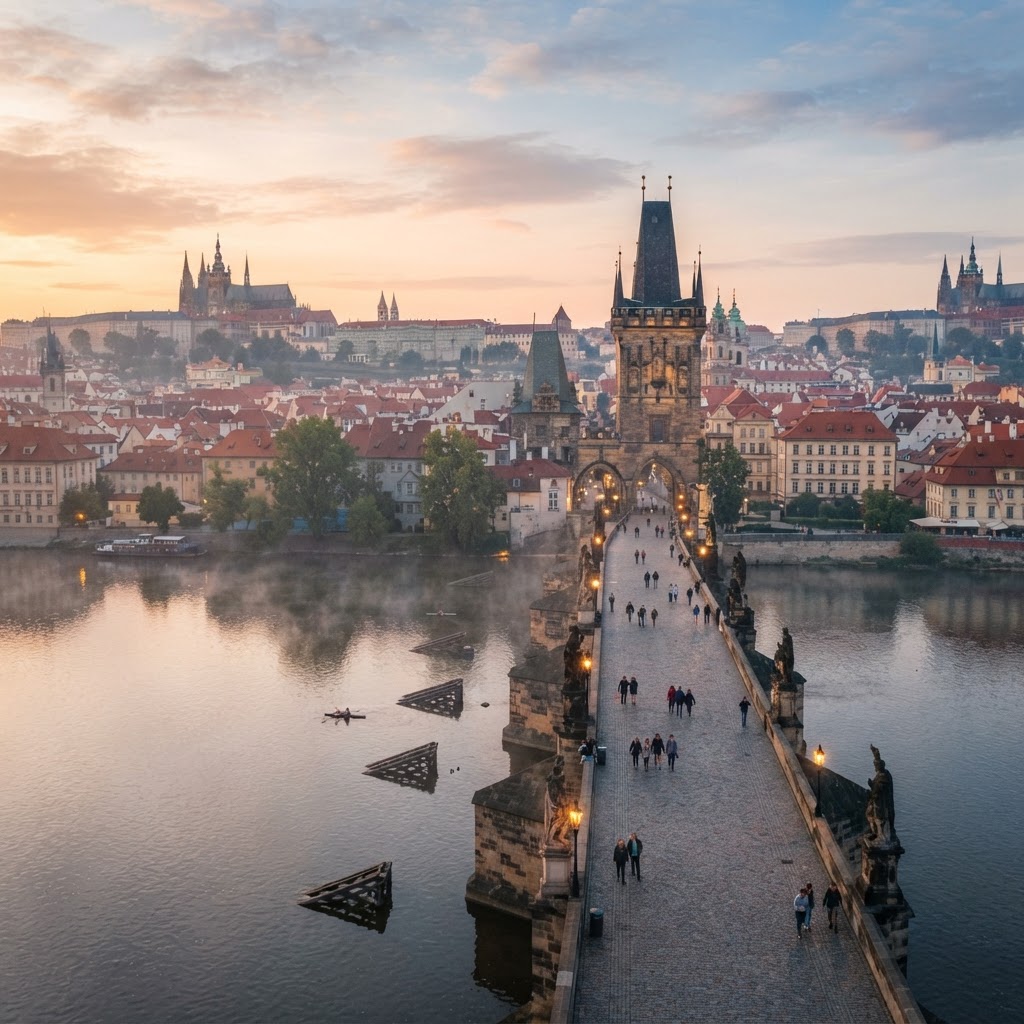
At first light on Charles Bridge, the stones hold the night’s cool beneath your feet. Prague is still gathering itself: the river moves below, footsteps sound distinctly on the bridge, and the silhouettes of the city’s historic buildings emerge as the light strengthens. There is the faint taste of morning air, with the first warmth of a drink in your hands if you have brought one; the stone feels solid and slightly uneven underfoot. Pause rather than hurry across. Look towards Prague Castle, then back along the bridge, and notice how the river divides the view without separating the city’s parts. The scene is quiet enough for small sounds to matter: a shoe on stone, the water, the gradual arrival of other people. In that moment, the Czech Republic comes into focus not as a checklist but as a place where history is built into the route of ordinary movement. The same country widens beyond Prague into Bohemia and Moravia, from Karlstejn Castle to the landscapes of Bohemian Switzerland National Park. Yet the bridge holds the essential tension together: a lived city and an enduring past, close at hand, crossed on foot.
The story behind it
The Czech Republic’s heritage is visible in places that carry different kinds of memory: Prague Castle and Charles Bridge in the capital, Old Town Square as a civic setting, and Karlstejn Castle as a further architectural landmark. The country’s present geography is that of a landlocked state in Central Europe, with Bohemia and Moravia among its defining regions. Its history should not be reduced to a seamless succession of monuments or a single national narrative: buildings and public spaces are inherited through changing political and social circumstances, including difficult periods that a measured account cannot erase. These places are best approached as evidence of layered history, rather than as scenery detached from the people and events that shaped them.
Before you go
Let Prague be an opening, not a conclusion. The country’s regions and varied places reward a slower itinerary, one that allows the city’s historic intensity to settle before the landscape changes around you. From Bohemia to Moravia, follow the contrasts that interest you: a castle, a spa-town setting, a city beyond the capital or a national park. The journey need not claim to explain everything; it can simply make room for the country’s different scales and histories.
A landlocked centre
The Czech Republic occupies a central position in Europe and shares borders with Germany, Poland, Slovakia and Austria; its geography is defined by an inland setting, not a coastline.
Regional names endure
Bohemia and Moravia are among the country’s named geographic regions, giving a journey beyond Prague a regional framework as well as a change of scenery.
April–June
Spring into early summer
Spring and early summer generally bring mild conditions for walking around Prague and combining historic places with time outdoors in Bohemian Switzerland National Park. Pack for changeable weather, especially when moving between city streets and open landscapes.
September–October
Autumn shoulder season
Early autumn can suit a mixed itinerary through Bohemia and Moravia, with comfortable conditions for city visits and outdoor excursions. As the season advances, expect cooler days and shorter daylight; plan longer walks accordingly.
December–February
Winter conditions
Winter is cold, with the possibility of snow and icy conditions. Prague’s historic interiors and urban settings can still anchor a visit, but allow for warm layers, weather-dependent walking and less daylight for excursions beyond the city.
FAQ
The currency is the Czech koruna. Cards are useful in cities, but carry cash for smaller or rural purchases.
May to September usually brings longer, milder days for walks; spring and autumn are changeable, and winter can be cold or snowy.
Yes. Tap water is generally safe to drink in Czech Republic.
Traffic drives on the right. Plan rural journeys carefully, as the final leg may need local transport.
Not everywhere: historic pavements can be cobbled or steep, and step-free access varies. Confirm routes and accommodation access before booking.
Reserve ahead when you need a particular guide, language or entry time, especially for popular places such as Prague Castle and Karlstejn Castle.
Call 112 for emergency assistance in Czech Republic.
Before you go
The last thing most travellers forget — and the disclosure that applies to every partner link on this page.
Booking and rate checks run on the partner's own site; prices and availability are theirs and can change. Some links are affiliate links and Makutet may earn a commission at no extra cost to you. See our affiliate disclosure.
Destinations
1 published destination
Makutet builds a day-by-day itinerary around the places above — then keeps it updated as you travel.
Country guide: /country/czech-republic
Your assessment works without optional tracking. Necessary storage keeps your trip and privacy choice. Embedded flight search includes TravelPayouts tracking; ordinary partner links remain available if you decline.
Cookie policy · Privacy policy. Reopen Cookie settings to change your choice. Supplier-site cookies are controlled by that supplier.